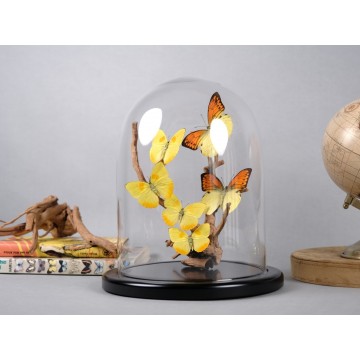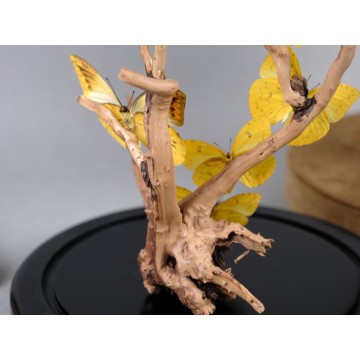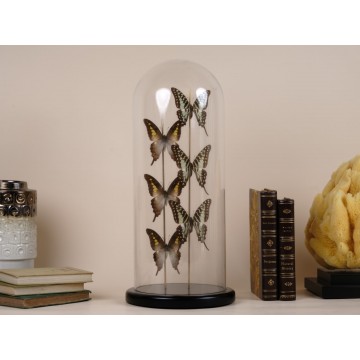
Epitonium scalare dome
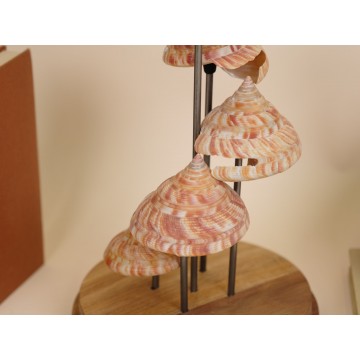
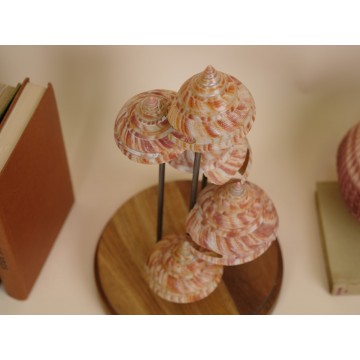
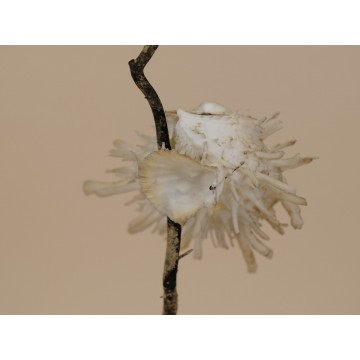
A beautiful glass dome with 7 Epitonium scalare and a few small corals.
Epitonium scalare is a classic elusive species, from Philippines.
A beautiful glass dome with 7 Epitonium scalare and a few small corals.
Epitonium scalare is a classic elusive species, from Philippines.
A huge size, close to 140mm Hexaplex regius from Mexico, showing its beautiful aperture with no defects.
Mounted in a black lacquered wood base.
Syrinx aruanius - Australian Trumpet shell in a dark brass base.
It's a species of extremely large sea snail measuring up to 91 cm long and weighing up to 18 kg. Shells over 50 cm are now impossible to obtain, specially in good condition. It is a marine gastropod mollusk in the family Turbinellidae, and is the only species in the genus Syrinx.
This one is open into an spiral shape, handmade by local artisans from Indonesia.
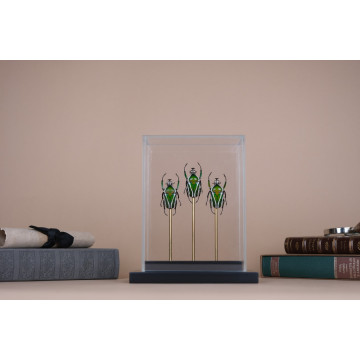
This beautifully curated glass vitrine showcases four specimens of Rhomborhina resplendens Scharzt, 1817 — known for their striking Electra green coloration. These remarkable beetles belong to the coveted group of jewel scarabs, highly sought after by collectors for their metallic brilliance and rarity.
Native to Thailand, these scarabs captivate with their vivid hues and delicate forms, making them equally compelling as both scientific specimens and sophisticated decorative objects.
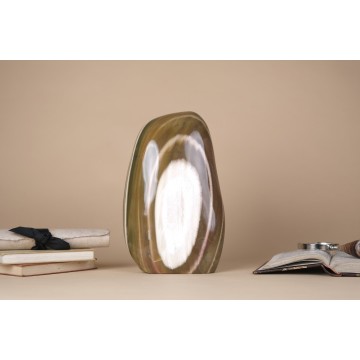
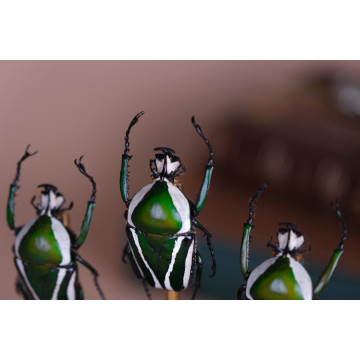
A beautiful glass vitrine with a male and female of Mecynorhina torquata, is among the largest flower beetles in the world, only surpassed by the goliath beetles.It reaches about 55–85 millimetres (2.2–3.3 in) of length in the males, while the females are slightly smaller, reaching about 50–60 millimetres (2.0–2.4 in) of length.
Also a male and female of Mecynorhina ugandensis that differs from the torquata in the colour more brown and slightly bigger. These beetles are native to tropical Africa, especially in the Democratic Republic of the Congo, Cameroon and Uganda. In this case they came from Uganda.
Rainbow Banded Fluorite crystal in its natural form.
The colouring of these stones ranges from yellow, through green to purple with the natural banding showing. There may be some matrix (bed rock) attached and some natural staining. This stone stabilizes the emotions and increases self-confidence.
From Deqing Fluorite Mine in Zhejiang Province -China- this piece has perfect layers of purple and transparent, mounted in a handmade brass base.
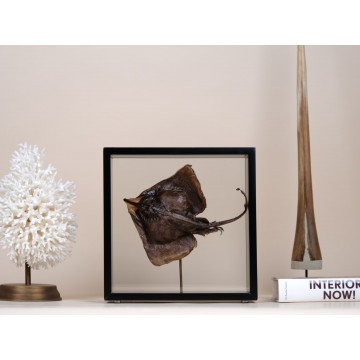
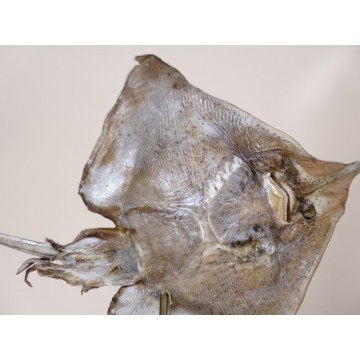
Sugar Sea star in a white wood glass frame.
One of the most elusive species of starfish, very big size, from Gulf of Mexico.
An exceptional and pristine specimen of remarkable size and quality, displaying a rich caramel-golden hue.
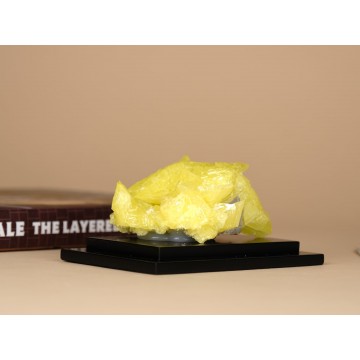
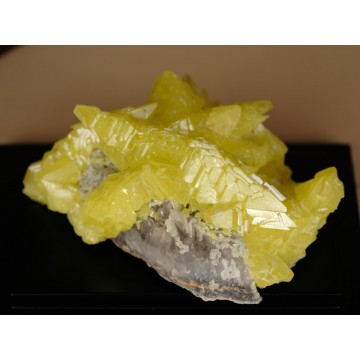
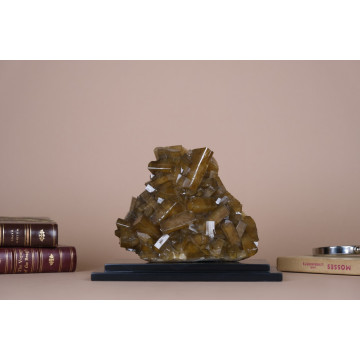
Barite, a barium sulfate mineral (BaSO₄), is renowned for its high specific gravity, giving it an unusually heavy feel for a non-metallic mineral. Its striking crystal formations and warm coloration make it highly sought after by collectors worldwide. This outstanding piece originates from the famous Xiefang Mine in Jiangxi, China, and is mounted in a double black lacquered wood base.
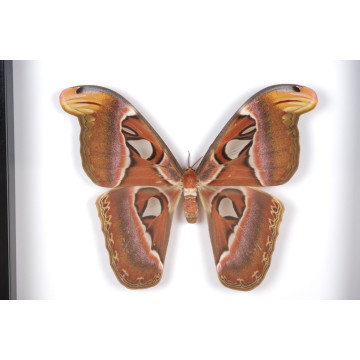
Attacus atlas, the Atlas moth, is a large saturniidae moth endemic to the forests of Asia. One of the largest lepidopterans, with a wingspan measuring up to 24 cm (9.4 in).
This beautiful species came from Thailand.
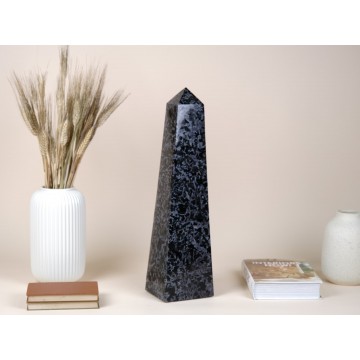
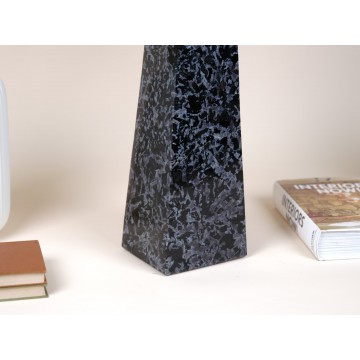
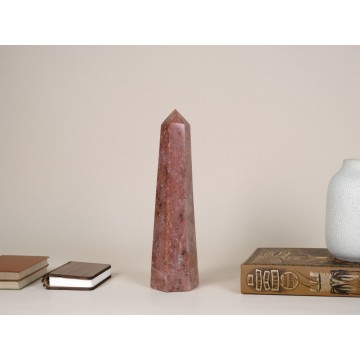
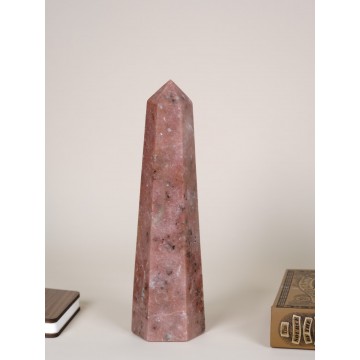
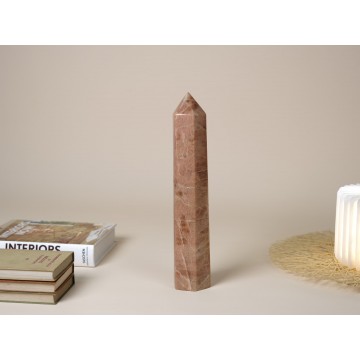
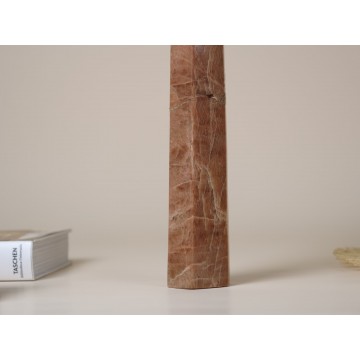
Beautiful red calcite that has been polished into the shape of a six sided obelisk. The base of the obelisk is flat, allowing for aesthetic presentation.
This red calcite was mined from the Norcross-Madagascar orange calcite quarry. This type of calcite likely occurred as a massive conglomerate, formed from mineral rich water solidifying following accumulation as flowstone and/or through precipitative processes.
A great decor item.
A stunning cluster of lustrous bipyramidal Smoky Quartz crystals. While exhibiting minor imperfections, this piece remains an exceptional decorative specimen. Sourced from Baotou City (Baotou Prefecture), Inner Mongolia, China.
Mounted on a handmade dark brass base.
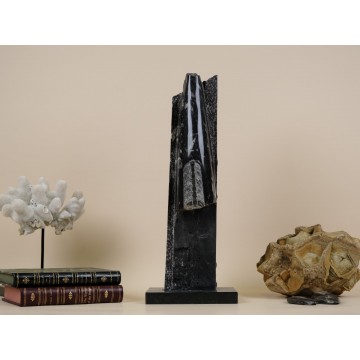
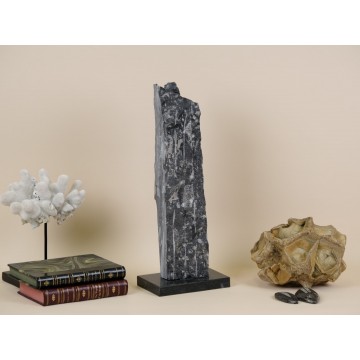
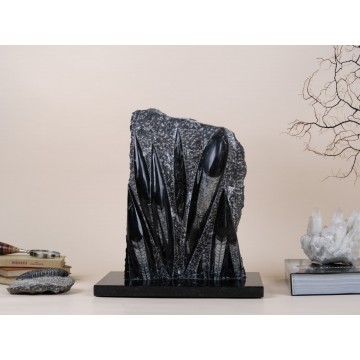
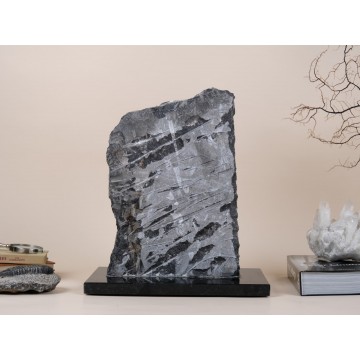
Orthoceras column fossil, a captivating relic hailing from a time more than 400 million years ago. These prehistoric squid-like beings, preserved through eons within oceanic sediments, offer an unparalleled glimpse into the past. Elegantly aligned by primordial currents on the ocean floor prior to their entombment, these creatures maintain their relative positions, frozen in the embrace of time.
Skillfully revealed through meticulous exposure and a masterful polish, the fossils come to life against their matrix backdrop. The artful interplay of light and shadow accentuates the delicate features of these long-extinct cephalopods. With their tentacles and ink sacs, reminiscent of their modern-day squid counterparts, these creatures possessed a mystique that transcends eras. Notably, these cephalopods boasted external shells, characterized by hollow internal chambers partitioned by intricate walls known as septa, a fascinating trait shared by their kin.
Originating from the Devonian period approximately 410 million years in the past, this fossil bears witness to the eons that have passed, finding its origin amidst the rugged landscapes of the Anti-Atlas Mountains in Southern Morocco.
Kambamba Jasper bowl, from Kambamba – Madagascar.
Spectacular green and black eyes pattern with “swirling” colours it is a very sought piece! Kambamba Jasper, also known as Kambamba Stone, Crocodile Jasper or Green Stromatolite Jasper - due to its colour and pattern - is an extremely old stone dating back to 3 billion years ago.
Nowadays it is considered a fossil classified as a stromatolite because of the fossilised algae that created this mineral.
Kambamba is a very energizing stone which activates our root and heart chakras, achieving an emotional balance throughout the day.
One of a Kind piece!
Beautiful specimen of Labradorite.
This mineral belongs to the feldspar group and the high iridescent variety is called Spectrolite.
The name came from the first findings of this elusive specimen that have been found in Labrador, Canada.
This one came from Madagascar where high quality material have been found as well!
Great energetic and healing powers are attributed to Labradorite.
Placed into a decoration it enhances harmony! Every piece is "one of a kind", polished by hand from the nature.
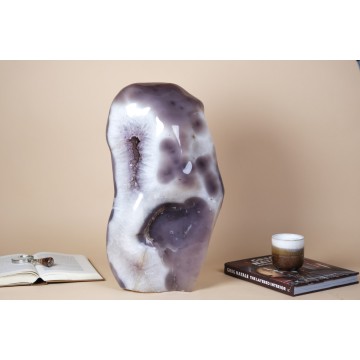
This beautiful septarian egg from Madagascar shows its interior crystallization in contrast with exterior colors.
Septarias are prehistoric marine nodules of bio sedimentary origin followed by dehydration during diagenesis, which today are found as large pebbles in clay soil. The creation of a Septarian is a succession of events along millions years, they form around a core of organic matter (plant or animal).
Sediments continue to settle on the nodule, compacting it under their weight which will flatten it and expel water, while inside micro-cracks begin to form, amplified by tectonic movements. It is in these shrinkage slots that over time dissolved minerals will crystallize.
Its name comes from the Latin "septum" which means partition, barrier, indeed, the polishing of the nodule reveals and sublimates its elegant marbling of black calcite, millions of years that offer these sumptuous minerals, each piece is unique!
Bismuth Cathedral crystals that truly command attention. Bismuth, a fragile yet crystalline material, finds itself within the realm of semi-precious semi-metals, naturally adopting captivating geometric forms that are utterly distinctive. Infused with refractive properties, it dazzles with an opulent, iridescent sheen reminiscent of an enchanting oil-slick spectrum. Historically sourced as a by-product from the depths of copper, lead, and tin mines, it once confounded ancient observers, often being mistaken for lead or tin due to its beguiling appearance.
When ignited in the presence of oxygen, bismuth dances with a sapphire-blue flame, releasing ethereal yellow fumes as its oxide is formed—an intriguing testament to its chemical nature. As rare as precious silver and possessing the heftiness akin to lead, a cubic foot of bismuth would staggeringly weigh over 600 pounds, attesting to its density.
These extraordinary Bismuth crystals, nurtured within laboratory environments in the United Kingdom, emerge as a rarity, as their naturally occurring counterparts remain elusive treasures. Their unique kaleidoscope of hues and mesmerizing contours positions them as sought-after ornamental pieces, gracing spaces with unparalleled allure. Beyond their aesthetic significance, these crystals also find pragmatic roles in medicines, cosmetics, inks, paints, and even fire sprinkler systems—a testament to their versatile utility.
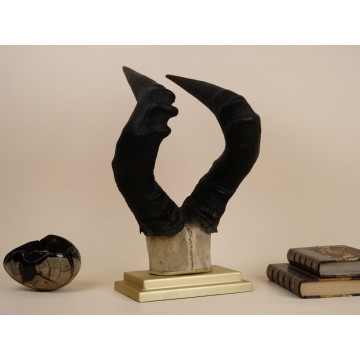
Chrysocolla and Malachite slice - showcasing a superb pattern and color from these two copper ore minerals. These formations, cut and polished, exhibit beautiful colors and patterns, making them among the finest specimens.
Originating from Kolwezi, Katanga, Democratic Republic of Congo. Mounted in a handmade dark brass base.
Heterometrus laoticus - Vietnam Forest Scorpion is a scorpion species found in peaty areas of Vietnam and Laos. They can reach lengths of up to 17 cm. They are a communal species, but cannibalism has been known to occur, and if caught, they can be extremely violent even towards their own kind.
Rather than being a lethal toxin, the giant scorpion's venom is paralytic. The venom is distilled into medicines against various kinds of microorganisms. It exhibits good results in disc diffusion assay for Bacillus subtilis, Klebsiella pneumoniae, Pseudomonas aeruginosa, and Staphylococcus aureus, among others.
The scorpion is farmed for consumption as a novelty food in Vietnam and Thailand. They are also used to make snake wine (scorpion wine).
This one is from a farm in thailand, mounted in a glass dome.
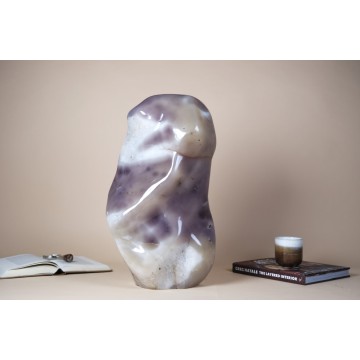
This beautiful septarian sphere from Madagascar shows its interior crystallization in contrast with exterior colors.
Septarias are prehistoric marine nodules of bio sedimentary origin followed by dehydration during diagenesis, which today are found as large pebbles in clay soil. The creation of a Septarian is a succession of events along millions years, they form around a core of organic matter (plant or animal).
Sediments continue to settle on the nodule, compacting it under their weight which will flatten it and expel water, while inside micro-cracks begin to form, amplified by tectonic movements. It is in these shrinkage slots that over time dissolved minerals will crystallize.
Its name comes from the Latin "septum" which means partition, barrier, indeed, the polishing of the nodule reveals and sublimates its elegant marbling of black calcite, millions of years that offer these sumptuous minerals, each piece is unique!
Diplomystus Dentatus fish from the Paleogene, Eocene, 53.500,000 to 48.500,000 years.
An ancestor of the herring family, a very finely boned fish which is extremely difficult to prepare from the Lagerstätte varve layer of the Eocene limestones of the Green River formation 18-inch layer.
These predator fish came from the prehistoric fossil lakes. The lower Eocene deposits of Green River formation was thought to be a large freshwater lake. The calcite would be absorbed by the remains of the fish, transforming their bones into a hard mineralized deposit in the slightly softer and lighter colored limestone shales.
Mounted in a handmade brass frame that can be fixed in three different ways.
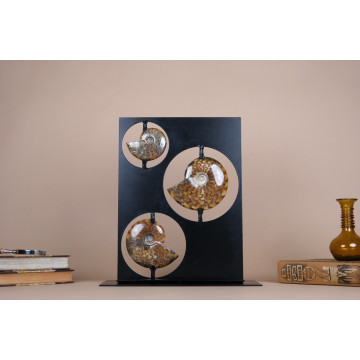
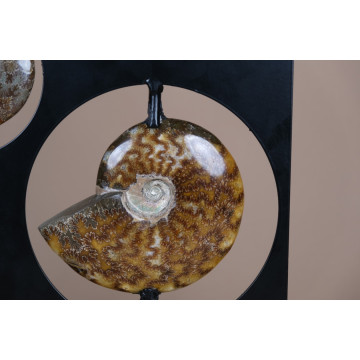
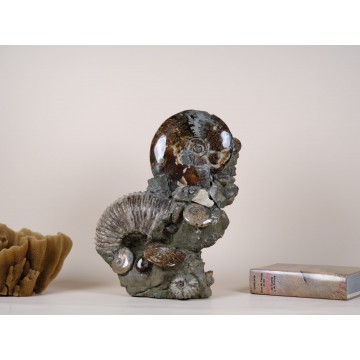
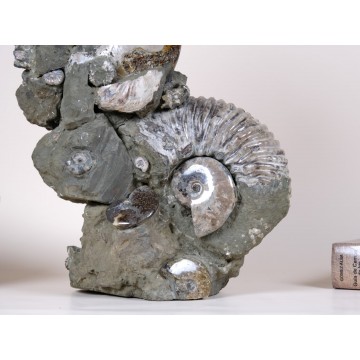
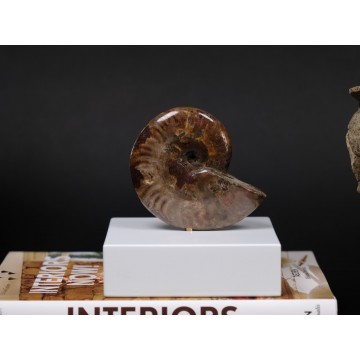
Stunning ammonite with red opalization on the surface, in a white lacquered wood base.. Ammonites were predatory mollusks that resemble the squid we know today.
These cephalopods had eyes, tentacles, and spiral shells. Ammonites are closely related to a living octopus, though the shells resemble that of a nautilus.
Every stone is unique and one of a kind. These fossils come from the Mahajanga River Basin, near the village of Ambatolafia of northwest Madagascar, located in the former province of Mahajanga/Majunga. They are dated from the Early Cretaceous period, Albian age (100 to 113.0 million years ago).
Beautiful specimen of Labradorite, this mineral belongs to the feldspar group and the high iridescent variety is called Spectrolite.
The name came from the first findings of this elusive specimen that have been found in Labrador, Canada.
This one came from Madagascar where high quality material have been found as well!
Great energetic and healing powers are attributed to Labradorite.
Placed into a decoration it enhances harmony! Every piece is "one of a kind", polished by hand from the nature.
Microcline is an important igneous rock-forming tectosilicate mineral. It is a potassium-rich alkali feldspar. It is common in granite and pegmatites. Microcline forms during slow cooling of orthoclase. Microcline may be clear, white, pale-yellow, brick-red, or green; it is generally characterized by cross-hatch twinning that forms as a result of the transformation of monoclinic orthoclase into triclinic microcline.
This specimen came from Madagascar and have a unique coffee and milk colour. The polishing work is made by local people.
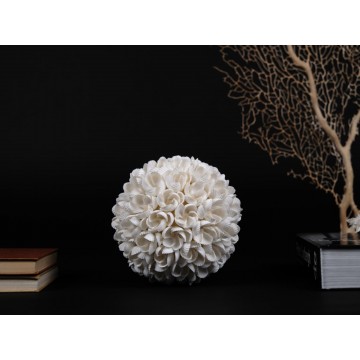
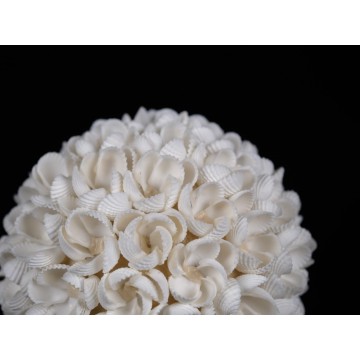
A beautiful Shell ball made with Strombidae shells, from Indonesia.
These balls are part of the Indo-Pacific cultural heritage, and from a long time tribal people use them as adornment pieces. Today they are natural and beautiful decor pieces.
A superb polished Haliotis assimilis tray table in satin brass. Look like a Victorian table piece.
With six Haliotis shells polished on both sides, ideal for bringing nuts or sweets to the table.
Unique One of a Kind design piece.
A stunning combination of flawless, well-formed blue Aquamarine crystals elegantly perched on a matrix of shimmering Muscovite and vibrant blue Fluorite.
This exceptional mineral assemblage is highly sought after by collectors for its rarity and aesthetic appeal.
Such remarkable specimens are exclusively sourced from the renowned mines of Nagar, Shigar Valley, Skardu District, Pakistan.
Mounted in a handmade dark brass base.
Discover the extraordinary rarity and captivating beauty of these crystals—a harmonious blend of pale hues interwoven with the elusive blush of pink. The exquisite colors are a testament to the presence of phosphates and aluminum, creating a visual tapestry that is as rare as it is enchanting. Their unconventional and intriguing shapes only add to their desirability.
Sourced from the renowned Choique Mine in Neuquen, Argentina, these crystals are a testament to the Earth's remarkable artistry.
Beyond their aesthetic appeal, Rose Quartz and Amethyst, when paired together, hold the power to transmute negative energy into a positive force. These crystals can also offer solace from the symptoms of depression and anxiety by elevating one's vibrational energy. Wearing Amethyst and Rose Quartz daily can cocoon you in a loving and positive energy field, surrounding you with their uplifting influence.
A Papilio family frame, displaying:
Papilio maacki - from China
Papilio memnon - from Thailand
Papilio nireus - from Congo
Papilio delalandei - from Madagascar
Papilio lormieri - from Congo
Papilio antenor - from Madagascar
Beautiful set on a white wood frame.
Shiva Lingam stones are a distinctive elongated egg shape thought to represent the cosmic egg of which all life has sprung.
The name Lingam is translated from Sanskrit word linga meaning symbol. Sacred for the Indus is also much prized for people all over the world that believe in the power of the stones.
This Lingam stones are handmade in Madagascar using the beautiful Golden Septarian stone.
A beautiful Shell ball made with Cerithiidae shells, from Indonesia.
These balls are part of the Indo-Pacific cultural heritage, and from a long time tribal people use them as adornment pieces. Today they are natural and beautiful decor pieces.
Superb Heteropterix dilatata from Malaysia in a black wood frame.
Heteropteryx dilatata is the only described species and gives its name to the family of the Heteropterygidae. Their only species may be known as Jungle nymph, Malaysian stick insect or Malayan wood nymph and because of their size it is commonly kept in zoological institutions and private terrariums of insect lovers. It originates in Malay Archipelago, more precisely on the Malay Peninsula and Borneo and is nocturnal.
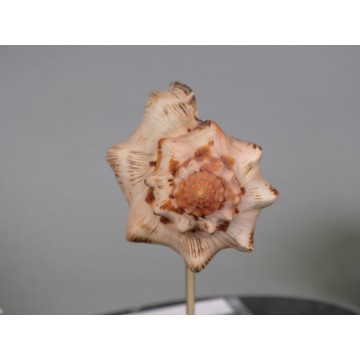
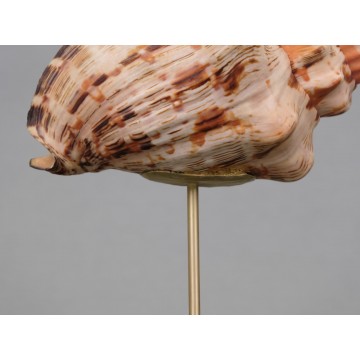
Melo umbilicatus - Melon shell in a brass base, from Arafura Sea. Indonesia.
This species belong to the Volutidae family, generelly big sized shells. Can reach near 45 cm, gargantuam specimen usually are very scared and few pattern. This specimen is a medium size one but is beautifully patterned.
Heterometrus laoticus - Vietnam Forest Scorpion is a scorpion species found in peaty areas of Vietnam and Laos. They can reach lengths of up to 17 cm. They are a communal species, but cannibalism has been known to occur, and if caught, they can be extremely violent even towards their own kind.
Rather than being a lethal toxin, the giant scorpion's venom is paralytic. The venom is distilled into medicines against various kinds of microorganisms. It exhibits good results in disc diffusion assay for Bacillus subtilis, Klebsiella pneumoniae, Pseudomonas aeruginosa, and Staphylococcus aureus, among others.
The scorpion is farmed for consumption as a novelty food in Vietnam and Thailand. They are also used to make snake wine (scorpion wine).
This one is from a farm in thailand, mounted in a frame.
A spectacular Spondylus variegatus attached in a Malleus malleus shell from Davao - Philippines, in a white lacquered wood pedestal.
The Spondylus is a marine bivalve from the Spondilidae family, perfectly preserved. The Malleus malleus shell a marine bivalve mollusk in the family Malleidae, it is also known as the black hammer oyster.
This is a uncommon attachment that came out by divers from time to time.
The two shells live in perfect symbiosis.
A beautiful Shell ball made with Cardiidae shells, from Indonesia, mounted in form of flowers.
These balls are part of the Indo-Pacific cultural heritage, and from a long time tribal people use them as adornment pieces. Today they are natural and beautiful decor pieces.
Marine life glass dome composed by: small Gorgonia from de Indo-Pacific, one coral Montipora sp., two Fusinus colus, one Fusinus undatus from Balicasag - Philippines, three Mitra mitra from Punta Engaño - Philippines and one beautiful Xenophora pallidula from deep water of Davao - Philippines.
Also three white sea stars and one sea bisquit all from Caribbean Sea.
One of a Kind handmade piece!
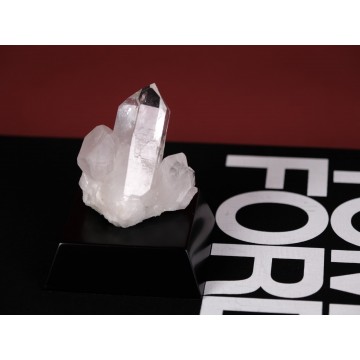
An outstanding clear Quartz cluster from the famous Arrowhead mine, Hot Springs – Arkansas (USA), mounted in an iron base.
From an old collection, this is a museum piece, with the typical form of the crystals from this mine.
A beautiful Smoked Quartz cluster from Shandong region, China.
Always a must either for collectors or to decor, intricated crystals, mounted in a handmade dark brass base.
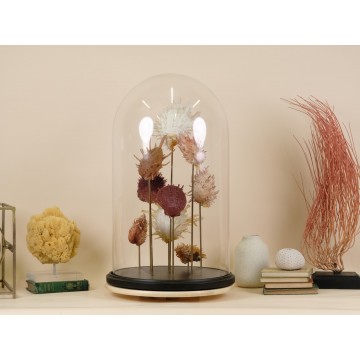
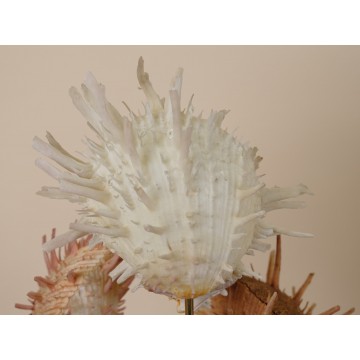
Marine Life glass dome with a Yellow hardhead sponge from Florida - USA, a big Scottish Sea urchin from North Sea - UK, Metalia sternalis from Mactan Islands - Philippines, Bolma girgyllus from Palawan Islands. - Philippines and Pocillopora eydouxi from Solomon Islands.
Beautiful colorful decor piece.
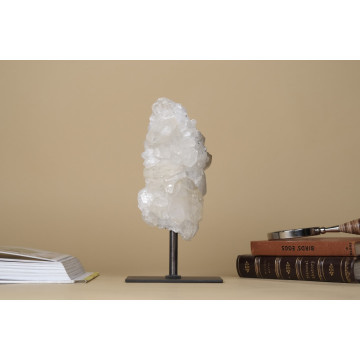
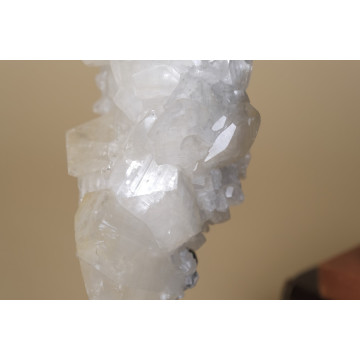
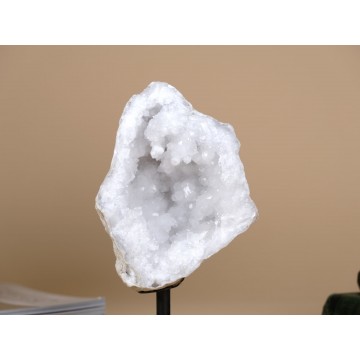
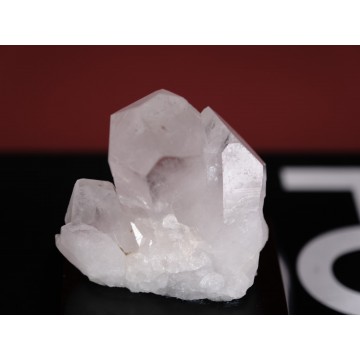
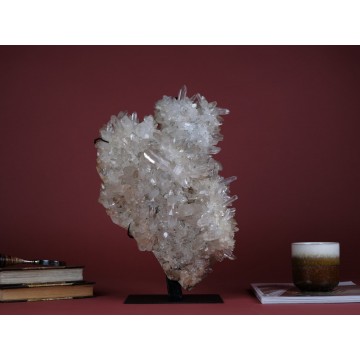
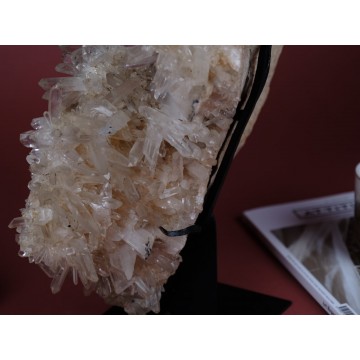
Hyaline Quartz clusters from Inner Mongolia, China. Discovered in 2012, these exquisite specimens are sourced from small mines, presenting themselves in a myriad of captivating forms. As the exploration of this crystal is still in its early stages, the true extent of its remarkable properties is just beginning to unfold.
In the realm of healing, Mongolian Quartz is revered for its transformative power, acting as a catalyst to cleanse and purify the energetic bodies. It gracefully dissolves lingering emotional blocks, paving the way for release and forgiveness. This extraordinary crystal becomes a guiding light, illuminating a pathway towards letting go of past burdens and embracing a renewed sense of liberation. Embrace the boundless potential of this captivating gem as it accompanies you on a profound journey of inner healing and spiritual growth.